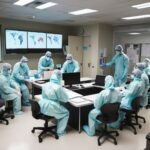



Want to stay in healthcare but outside the hospital or clinic setting? Then public health may be the field for you. Public health is safeguarding the health and its determinants in a community. In easier terms, it is a collective effort to prevent a presumably healthy person from getting a disease. It is also known as community medicine or community health in certain areas. Many people perceive doctors as working in hospitals and clinics, but these cater for sick individuals. During COVID-19 pandemic, for example, much of the coordination are done by public health professionals. But what actually public health professionals are? They can be the district health officer, environmental health officer, health promotional officer and even entomologists, which is expert in insects. They are a diverse group of people whom I can call colleagues in preventive health agenda. We will go through some of their roles. Outbreak prevention and control During COVID-19 pandemic, we can see that the health inspectors often call patients to ask them what are their symptoms, how many days of quarantine and if they have already swabbed or taken sample to confirm. They are responsible to break the chain of transmission by spreading facts, prevents misinformation and minimizing the risk of infection to other people. They are also responsible to check the vaccinations status and do risk assessment before taking action. These information are then being fed to their bosses, discussed and tabled for public health action. Standard operating procedures are improved, only to reach to the ultimate goal of safeguarding community health. Ensuring clean water provision Water sampling is conducted along sampling points and treatment plant in a designated area. It is done by the Kualiti Mutu Air Minum (KMAM) team of the local district health office. The main aim is for surveillance purposes for heavy metals and microbacteria. The technique involves the principle of sterilization by heat, then sampling using infection control measures. Overall, parameters of chlorine residue, pH, turbidity, color are checked. Furthermore, bacterial culture is sent for analysis. This is integral in monitoring the drinking water quality, hence preserving the health of the local community. Food safety and quality Food premise is one of the area potential for disease transmission such as foodborne illness. The main reason for foodborne illness in Malaysia is insanitary food handling procedures which contribute to 50% of the cases. For instance, the preparation of food in advance, inappropriate ways of cooling and insufficient temperature during reheating of food. All of these mishandlings permit the growth of microbial pathogens because they fail to kill the bacteria or they help to keep the bacteria dormant before they reach sufficient temperature to multiply. It is known that temperature play important part to determine the microbial activity and shelf life of food product. Hence, temperature manipulation, as well as hygiene and sanitation of kitchen environment should be the highest priority to ensure safe foods with low risk of contamination are served to consumers. Ministry of Health Malaysia has been collecting food samples from various food premises to determine whether food service establishment prepare food according to the accepted requirement. Each year, more than 10,000 food items were sampled for analysis to determine whether food items are safe for consumption. The government has implemented laws regarding the hygiene level in the food premises. Any premise that is categorized as dirty will be forced to close down its operations. The public health professionals involve in this operation include, but not limited to, environmental health officer in charge of Unit Keselamatan dan Kualiti Makanan (UKKM) and food technology officer. This is to avoid foodborne outbreak to occur because, apart from getting sick and experience diarrhoea, foodborne diseases can cause mortality and it can easily affect the young, old and immunocompromised person compared to other healthy individuals. In Malaysia however, most of foodborne diseases are associated with food handlers’ insanitary procedure during food manipulation whereby improper food handling might transfer pathogenic bacteria to food item and cause illness. Public health professional enforces food-related laws such as: Covers the area of food/sources, premise and its handlers, import and export, activities related to food including analysis, related laws such as international health regulation (IHR), delegation of power, enforcement and punitive actions. Covers the area of sampling procedure, labelling, food additive and nutritive supplement, packages for food, incidental constituent, standards and particular labeling requirements (for specific food products) Both of these laws are enforced together on 1st October 1985. One man’s preventive effort is another man’s health provision These are just some of their job scopes. In summary, public health professionals work backdoor hence the contribution may not be seen as people are presumably healthy in public health programmes conducted nationwide. Nevertheless, they are unsung heroes. The nation should invest in preventive care rather than just curative care as it is the strongest determinant of good quality of life, in line with Sustainable Development Goals (SDG) number 3 which is good health and wellbeing. I will share job opportunities for public health locally and internationally in later posts. Stay tuned.

Starting in 1950s, AI has bloomed tremendously in recent years. AI has been one of the most popular tools in this digital technology era, an era whereby everyone wants a piece of AI ; be it digital marketing, arts and medical education. As a medical lecturer and academician, I find it important to embrace AI rather than distrusting it wholly. However, there are some caveats. Two-tails During my biostatistics class, I teach my students the concept of two-tailed hypothesis. To give example, let say a person wants to know if AI can generate an image of an older version of himself. Two-tails here means it either can generate a real image of an older version of himself or an image of a completely different person. It can either go right (the truth) or left (the fallacy). Thus, the AI model can be either great or downright misleading. This has some repercussions, especially in medical education. Can we allow AI to take over medical education? AI in Medical education : the good stuff Medical learners can be classified into undergraduate, postgraduate and other medical professionals aimed at acquiring knowledge in medicine. Before this, there was only a notebook and a pen or pencil. Even the famous medical illustrator and surgeon, Dr Frank H. Netter, drew by hand the human body which was a remarkable feat during his time and even now. However, have you ever thought of learning anatomy at your home without actually looking at a cadaver? A cadaver is a dead body, by the way. This concept is known as virtual reality (VR) and, to a certain extend, augmented reality (AR). You can dissect the body in real-time without the need to smell the formaline-covered cadaver. It really enhances learning and makes learning equitable. If a professor in anatomy demonstrates the dissection in a large group, only a handful will benefit. With VR, every student can learn and do themselves. Ethical issues of AI in medical education The issue comes when the students wanted to submit their written essay assignments. The irresponsible ones will abuse generative AI such as ChatGPT to finish it fast. Let me give you an example. The question will be: Explain the importance of tuberculosis prevention. Through my knowledge at the time of writing, my answer is: “Tuberculosis prevention is done to break the chain of transmission. It encompasses awareness on the mode of transmission, which is respiratory droplet, hence wearing mask especially N95 is a necessity. Ensuring good ventilation and avoid over crowdedness is also important. It can be controlled by ensuring patients get their directly-observed treatment, short course (DOTS) at the nearest health clinic” If we use the same question (or prompt as they call it) in ChatGPT, the answer will be: Hence, as you can see the answer is human-like and quite comprehensive. There is a move in academia to use software to check authenticity such as using Turnitin’s AI detector or GPTZero. How to solve this two-tailed dilemma?